


"What did you do tonight", you ask? I went through the 111 pages of orders/penalties issued against Bank of America - $1.2B from FinCEN, $750MM from the OCC and $11.6MM penalty from OFAC. I have 6-pages of lessons learned written by me, a human. The full writeup is below. Given that many will or have generated AI-synopsis of the facts, I will forgo that and provide the lessons learned only.
We will start with the lower $$ and move towards the FinCEN hefty penalty. Don’t have time to read through all this. There are FIVE consistent themes throughout all of these orders outlined at the end.
OFAC $11.6MM PENALTY
1) Wire data is clunky, difficult, and fraught with sanctions threats. So many FIs in the world, quick updates to lists, user interfaces that may have different options made available, etc. Oooofff. Bit them.
2) What have I been saying for a while now? Bad decisions are used to model future decisions… “—for example, if an alert was based on the exact same criteria as an alert that a Bank of America analyst manually dispositioned as a false positive in the past.”
3) Providers of OFAC lists are often times off the hook when it comes to their failures for not updating the lists on time. I cannot keep count of how many issues this has caused – for small and big FIs. This is why there must be ongoing QC of your sanctions source lists, because your vendor is not on the hook, you are.
4) Letter of the law indication? Possibly. Bank of America initially performed only a single, narrowly tailored lookback and did not identify the full scope of its payment activity involving blocked banks until after OFAC directed it to provide information”. Yikes. This is after they were aware that the routing directory had blocked banks and OFAC told them.
5) Prioritization of alerts. Is this properly tested in your sanctions and AML validations? High-risk setup – whatever it may be – in this case name and DOB matched and it was routed as low/med risk. If your validation is not covering this, send it back and ask for it.
6) The human error that mishandled two business accounts – gross misunderstanding of blocking requirements and how/where OFAC restrictions stand when dealing with UBOs and auth signers. That points to training issues.
7) BofA provided “piecemeal” and incomplete disclosures in responses to OFAC. Giving the Heisman to OFAC? Not a good idea.
OCC $750MM Penalty and 2026 Order
The 2024 order was a cease-and-desist that told BofA what to fix and explicitly reserved a penalty based on the same findings. I see this 2026 OCC order as a follow on. Honestly, it tells us how bad – and essentially the majority of my points from the 2024 order breakdown still stand. The OCC also says bluntly that progress since 2024 hasn’t been enough and keeps the right to add more penalties if the violations continue. Want a breakdown from that original post? There are 11 lessons learned, with 6-9 and 9-11 noted in the comments.
Credit cards again being in the spotlight. When will all FIs – big or small – fintechs and lendtechs understand that credit cards deserve their own validation, audit, review, and QC. Most FIs do not have these flowing through to their main monitoring programs. This is an area that really needs a deep-dive by all sanctions, AML and fraud teams. We have processors that outsource anywhere from some processing to all processing and monitoring – with 0 oversight by the fincrime teams. In addition, there is no cross-over between normal DDA activity and CC activity. This could be a topic all of it’s own. But as a practitioner, you must spend time getting to know what this looks like for your FI. Do you know how many times I’ve been told my FIs of all sizes that they outsource this or that function to their CC processor and if they needed to know anything, they would be alerted. HA! That’s not how any of this works.
HINT: if you are under $15B in assets, you most likely outsource some/all of this to a non-bank.
Foreign FIs and correspondent accounts were not outlined in specificity in the 2024 order. Simplified due diligence for foreign FIs and branches. Not sure how that got justified? HINT: if your FI is using the Wolfsberg CBDDQ and calling it “good”, I beg you not to. At Acceleron, we’ve redone this CBDDQ to be more focused on effectiveness, road testing their answers instead of these static yes/no answers. I would encourage you to do the same. The point is not asking questions a monkey could answer, but asking questions that speak to the heart of whether or not an FI is actually doing what matters, when no one is looking.
FinCEN’s $1.2B ORDER
CMLOs, TBML and foreign correspondent banking are the main focus, with some statistical hoop-jumping taking up most of pgs. 10-22. But don’t blaze past these pages, as they repeatedly talk about how micro-elements of risk (my words) are often times overlooked unless they are added to something else. Sometimes, some activity is alone suspicious enough to be looked at and doesn’t need eight-ways-to-Sunday other elements in order to get eyeballs on it.
DISCLAIMER: I can’t imagine the lift that goes into managing suspicious activity programs for a behemoth FI. So I can’t play armchair quarterback on these things, call me SB not TB. The best I can do is extract the lessons that are applicable to all FIs, regardless of size.
Suspicious Activity Programs
While this should be a hub-and-spoke type of approach with many facets and inputs into the ultimate goal of reporting SARs – when there are disproportionately bigger spokes (like LE referrals, other FIs, and manual referrals) taking up the majority of reporting, then it points to the automated system not being effective or tailored to the threats of the FI. This is a graphic I typically use in training/presenting.
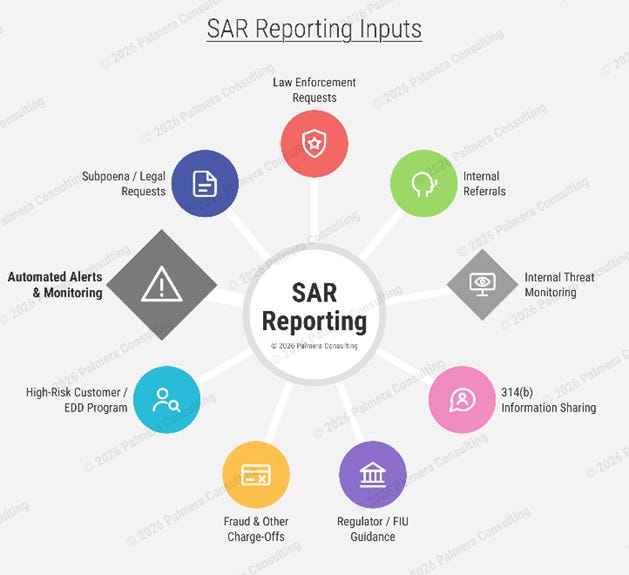
Another area that really doesn’t get a lot of attention, and you may have read right past it – “Additionally, the Bank filed a material portion of its SARs more than six months after the relevant activity took place in accordance with EP processes, which aggregated activity—often for extended periods of time—to determine if such activity was suspicious.” I take this to mean, that the timeframe used for aggregation and monitoring were not tailored to the threat they were looking for. Not all threats need two weeks, but not all need months and months. It depends on what threat you are looking for – and it must be tailored to that threat. And if you are using a longer timeframe, you must ensure that the investigative standards and turnaround timeframe doesn’t add on another 3-4 months of time to the filing date. A lot of money can move in 6 months. Don’t assign a general investigative timeframe for all alerts.
The dilution that resulted from what appears to be too complex of risk scoring (pg. 11 of the FinCEN Order) – is actually found in some of the more well-known community AML monitoring systems. They think they are covering all their bases in so many stinking risk factors, but when rolled up to groups, households, parties, etc. the risk factors get diluted, and therefore the risks are deluded.
Exempted customers (exempt from CTR reporting for non-US FIs reading) – MUST undergo suspicious activity reviews. The system used rescored/suppressed some high-cash flyers simply because they had an exemption. It is good to see this pointed out because I get push back ALL THE TIME from FIs. This could be a whole article on structuring, exemptions, and SARs, but I’ll just say this – many FIs exempt Phase II customers and turn-off their hyper-suspicious brain to the activity. Exemptions are hall passes to your customers, essentially stating to the IRS that you, their FI, will not report their cash activity as you trust that your customer is not being shady.
When 314(b) requests are not handled by effective, hyper-suspicious financial crimes investigators you get inaction on things that need action. See pg. 38 of the FinCEN Order for the prime example of what happens when a giant red flag is waved in an analysts’ face and it is largely ignored.
Negotiable Instruments
This was noted in the 2024 order breakdown, and it is good to see some more color. In my read/re-read of this, they are dinging BofA for not monitoring DEPOSITS of negotiable instruments, not purchases of instruments. Most FIs are not doing this – they are not parsing out check deposits into types of checks. There is a single tran code for check deposits, and a few more tran codes for check deposits via an ATM, night deposits, bulk, mobile, RDC, etc… but does not distinguish the underlying instrument as a negotiable instrument. Is this an expectation for all FIs? I mean, we still have FIs in the US that don’t have Check21 yet and some can’t even get their check images tied to their AML/fraud monitoring rules in one-click! Yes, the MICR line alone can most likely be used to determine negotiable instruments for non-tradFIs like WU, MG, etc. This is where a flexible monitoring system is your friend! If you have one of these systems, refer to pgs. 27-28 of the FinCEN Order for your starter/sandbox criteria.
Adverse Media
A sneaky little expectation that we all talk around but don’t really address. But this has come up recently with an insurance client of mine. What is considered adverse media? On pg. 32, FinCEN clearly expects that ALL media about the customer be searched AND then decided if it is adverse or not. I do not agree with this at all. “Rating model was designed to incorporate negative news, it failed to incorporate one customer’s public disclosure in a securities filing that it was under investigation by the Department of Justice for potential violations of money laundering laws.” WOW. So we need a news ticker for all securities filings and then determine if that filing mentions something risky? That’s a tough, impossible task.
Related, but not
A series of customers in the salvaged vehicle space are related by transactions, not ownership. Risks elevated in one of the three customers – and it did not appear to move the needle for a while, but when it did and they exited, no other reviews of the two remaining related-by-transaction customers occurred. This is a salient point. Often times, we exit relationships and don’t do a post-mortem analysis on what other tentacles they may have had at the FI. Pgs. 33-34 in FinCEN Order
Ch-ch-ch-changes
Many pages in this order address changes in actual activity or public-facing news or changes made to notes on a customer’s profile… and yet nothing changes towards filing SARs. While I do not agree that the expected vs. actual threshold is the best way to determine suspicious activity within the CRR, when there is an egregious outlier in activity from what was stated AND there is a major change in jurisdictional data points for transactions, there must be something material in the file to justify not taking mitigating/investigating steps. Pgs. 33-49 can be summed up like this – risky customers in high-risk industries generating a ton of TBML, fraud, and ML alerts and cases over several years… AMLO got continuously talked out of there desire to exit by this impactful relationship. Did they not learn anything from FIs and Epstein debacle? Either give the AMLO real, actual authority or don’t. Don’t act like it, then do something else when it gets tough.
Correspondent Banking
Banking foreign FIs or affiliates/branches that provide services to corporate customer is not the same thing as allowing your rails to be used for foreign MSBs and other foreign non-bank FIs clearing. This is nesting with a X factor of risk multiplication. See my earlier notes on FFIs in the OCC section above.
CMLOs and TBML
Need a starter packet for red flags related to CMLO activity? See top of pg. 59 of the FinCEN Order.
FIVE CONSTANT THEMES THROUGHOUT ALL THREE ORDERS
1) People. Humans in the fincrime function, matter. The way they are wired, matters. You cannot just throw training and assume they “will get it”. There are people who are wired to be effective sanctions and AML investigators. We have the solution to ensure that your hires are effective - Hyper-S Research. Check out our whitepaper here and take the free assessment to determine if your hiring process leaves your FI vulnerable to penalties and missed activity.
Do you have people in the chain, or possibly over the fincrime function, that are not wired to see threats and act accordingly? That seems to be a recurring issue throughout the 95 page FinCEN Order.
2) Data. This will be the end and beginning of everything. You cannot assume – “if I have data problems, I would know”. No. No you wouldn’t. You have to actively account and look for the data, follow to the source, and follow to your AML and sanctions system. You cannot have compliant AML or sanctions programs if you are missing data, transmitting inaccurate data, receiving clunky data, or have data unclassified or unused/screened. If you have knowledge, you have burden.
3) Authority. Not just in the CAMLO function. But throughout all three orders, there did not seem to be respect for authority outside of the Bank. OFAC reached out? Pssshhh. LE reached out? Pssshh. I don’t think this is currently the culture, but I couldn’t help but see the brightline between the true authority that was not given to the AMLO and the lack of acknowledging external authorities.
4) Threats. Having the fanciest monitoring system for transactions with layers upon layers of risk, or having statistically decent layered scoring for customer risk does not mean your FI knows your threats. Stay with me. For large FIs like BofA, there is always some statistical happenings because they cannot monitor all people and things. For all other FIs, I would encourage you to bucketize your threats. Not all threats are complex, some are single dimensional rules, some are not, and most are in between. If your validation is not helping you with this – and only ticking and tying known data fields to your AML system, get a new validation firm.
5) Sanctions. Not going away. And not just from this order, but also from the general temperature rising. I’ve been saying for years, that if your system is name screening and you think you are compliant with OFAC, you are missing it. We are seeing that now more than ever. Is sanctions the sexiest topic ever? No, of course not! But is it worth it, to hit pause and start to dig into your threats, data, geo footprint, etc? YES. This is my most requested training and speaking topic.
© 2026 Palmera Consulting
Well said